
Salesforce ANC-301 Implement and Manage CRM Analytics Online Training
Salesforce ANC-301 Online Training
The questions for ANC-301 were last updated at Apr 02,2026.
- Exam Code: ANC-301
- Exam Name: Implement and Manage CRM Analytics
- Certification Provider: Salesforce
- Latest update: Apr 02,2026
Universal Containers has a dashboard for sales managers. They need to visualize the percentage of their opportunities in the pipeline in a Gauge chart.
They want to customize the chart to keep track if they are below or beyond the target.
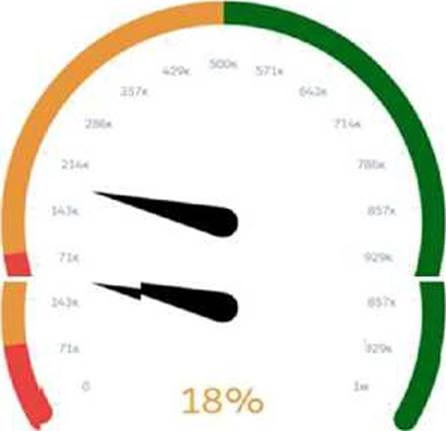
Which widget parameters should a consultant use?
- A . Range Values, Angle, Conditional Formatting
- B . Reference Line, Angle, Range Values
- C . Reference Line, Markers, Conditional Formatting
CRM Analytics team plans to enable data sync.
Which limit specific to data syne should the team consider before enabling the feature because it may impact existing jobs?
- A . Maximum number of data sync jobs cannot exceed the limit
- B . Maximum number of Full Sync connection mode enabled
- C . Maximum number of objects that can be enabled for data sync
A dashboard designer at Cloud Kicks creates a dashboard in CRM Analytics. The designer notices fields display on the dashboard with their API labels, such as "AccountId.Industry", and wants to change this behavior.
The designer also notices that the fields and their order appear to randomly change when a values table is created.
What should the CRM Analytics consultant explain to help the designer?
- A . The default fields in a values table can be changed by reordering how fields appear in the JSON of the value table.
- B . The default fields In a values table and the field labels can be modified in the dataset explorer.
- C . The field labels can only be changed in the widget properties in the dashboard edit mode.
Universal Containers (UC) is rolling out CRM Analytics to its field sales that include dashboards withorder data from an external source.
UC has a well-defined role hierarchy where everyone is assigned to an appropriate node on the hierarchy. In addition, the order data has a reference to a Salesforce opportunity.
An individual sales rep should be able to view all orders that they own or as part of the account team or opportunity team. The sales manager should be able to view all orders for the entire sales team. Similarly, the VP of sales should be able to view orders for everyone who rolls up in that hierarchy. The dataset has a field called Ownerld which represents the order owner.
Given this information, how should a CRM Analytics consultant implement the above requirements?
- A . As part of the recipe, use a formula on the Roleid fild to create an attribute called ‘ParentRolelDs’ on the dataset, and apply the following security predicate: ‘ParentRolelDs’ == ‘’$UserRoleId’’ || Owned == ‘$User,id\,
- B . As part of the recipe, use the flatten operation on the role hierarchy, create a multi-value attribute called ‘ParentRoleIDs’ on the dataset, and apply the following security predicate: ‘ParentRoleIDs’ == "$User.UserRoleld" || ‘TeamMember.Id’ ‘$User, Id" || ‘Ownerld’ == "$User.Id".
- C . As part of the recipe, use a multi row formula on the Roleld field to create an attribute called ‘ParentRoleIDs’ on the dataset, and apply the following security predicate: “$User.UserRoleld” || ‘Ownerld’ == “$User.Id".
consultant is reviewing a model that is set to maximize the daily sales quantity of consumer products in stores, and they see this recommendation.
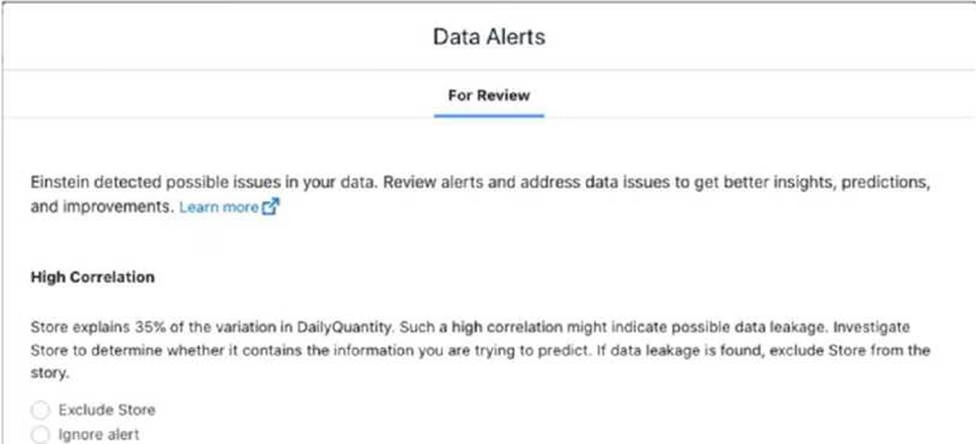
Which action should the consultant take?
- A . Verify client expectations that Store is a strong predictor for daily sales quantity.
- B . Remove the Store field from the model definition, because that is the recommended action.
- C . Ignore alert; the explanation of variation is only 35%, which is below 50%,
consultant is reviewing a model that is set to maximize the daily sales quantity of consumer products in stores, and they see this recommendation.
Which action should the consultant take?
- A . Verify client expectations that Store is a strong predictor for daily sales quantity.
- B . Remove the Store field from the model definition, because that is the recommended action.
- C . Ignore alert; the explanation of variation is only 35%, which is below 50%,
consultant is reviewing a model that is set to maximize the daily sales quantity of consumer products in stores, and they see this recommendation.
Which action should the consultant take?
- A . Verify client expectations that Store is a strong predictor for daily sales quantity.
- B . Remove the Store field from the model definition, because that is the recommended action.
- C . Ignore alert; the explanation of variation is only 35%, which is below 50%,
CXOs and VPs should have access to all data irrespective of the region (APAC, EMEA, etc.).
Which sharing method works for this scenario?
- A . Create two sets of dashboards; one for EMEA, and one for CXOs and VPs while filtering the dashboard on the region.
- B . Use a field on the user record like Department/Region, and apply row-level security based on that field.
- C . Create two separate datasets; one for EMEA, and one for CXOs and VPs.
A team of CRM Analytics developers has been working on an existing recipe to add new derived fields. The edited version has been failing ever since, and management is requesting that the dashboard show refreshed data while they work on the edits.
How can the developers add new fields while keeping the dataset refreshed?
- A . A recipe for the new fields and when that is successful, add it to the existing recipe as a join node.
- B . Clone the existing recipe to add fields and roll back the original recipe to the last working version.
- C . Refresh the dataset after working hours to avoid the edited version from failing.
A user is able to access the dashboards, lenses, and datasets of a particular app but is unable to
change the name of the specific app.
What is causing the issue?
- A . The user does not have Manager access for that app.
- B . The app name cannot be changed once created.
- C . The user does not have Editor access for that app.
Latest ANC-301 Dumps Valid Version with 242 Q&As
Latest And Valid Q&A | Instant Download | Once Fail, Full Refund
