
Amazon SOA-C01 AWS Certified SysOps Administrator – Associate Online Training
Amazon SOA-C01 Online Training
The questions for SOA-C01 were last updated at Feb 25,2026.
- Exam Code: SOA-C01
- Exam Name: AWS Certified SysOps Administrator - Associate
- Certification Provider: Amazon
- Latest update: Feb 25,2026
A SysOps Administrator is troubleshooting an AWS CloudFormation template whereby multiple Amazon EC2 instances are being created.
The template is working in us-east-1, but it is failing in us-west-2 with the error code:
AMI [ami-12345678] does not exist.
How should the Administrator ensure that the AWS CloudFormation template is working in every region?
- A . Copy the source region’s Amazon Machine Image (AMI) to the destination region and assign it the same ID.
- B . Edit the AWS CloudFormation template to specify the region code as part of the fully qualified AMI ID.
- C . Edit the AWS CloudFormation template to offer a drop-down list of all AMIs to the user by using the AWS: :EC2: :AMI: :ImageID control.
- D . Modify the AWS CloudFormation template by including the AMI IDs in the “Mappings” section. Refer to the proper mapping within the template for the proper AMI ID.
A company needs to have real-time access to image data while seamlessly maintaining a copy of the images in an offsite location.
Which AWS solution would allow access to the image data locally while also providing for disaster recovery?
- A . Create an AWS Storage Gateway volume gateway configured as a stored volume Mount it from clients using Internet Small Computer System Interface OSCSI)
- B . Mount an Amazon EFS volume on a local server Share this volume with employees who need access to the images
- C . Store the images in Amazon S3 and use AWS Data Pipeline to allow for caching of S3 data on local workstations
- D . Use Amazon S3 for file storage, and enable S3 Transfer Acceleration to maintain a cache for frequently used files to increase local performance
A
Explanation: https://aws.amazon.com/storagegateway/?whats-new-cards.sort-by=item.additionalFields.postDateTime&whats-new-cards.sort-order=desc
A SySOps Administrator has created a new Amazon S3 bucket named mybucket for the Operations team. Members of the team are part of an IAM group to which the following IAM policy has been assigned.
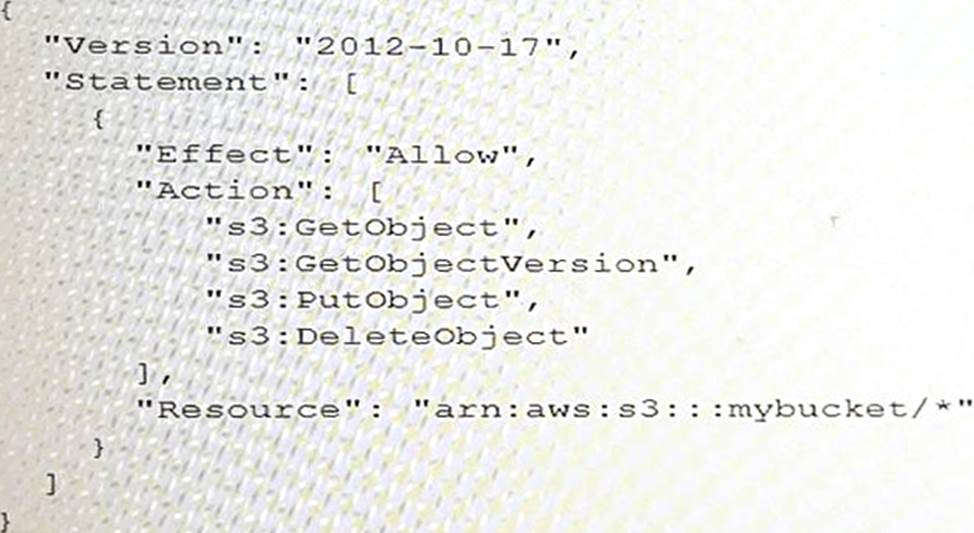
Which of the following actions will be allowed on the bucket? (Select TWO.)
- A . Get the bucket’s region.
- B . Delete an object.
- C . Delete the bucket
- D . Download an object
- E . List all the buckets in the account.
An application runs on Amazon EC2 instances behind an Application Load Balancer (ALB). The instances run in an Auto Scaling group across multiple Availability Zones. The Information Security team wants to track application requests by the originating IP and the EC2 instance that processes the request.
Which of the following tools or services provides this information?
- A . Amazon CloudWatch
- B . AWS CloudTrail
- C . Elastic Load Balancing access logs
- D . VPC Flow Logs
B
Reference: https://boto3.amazonaws.com/v1/documentation/api/latest/reference/services/elb.html
A SysOps Administrator must ensure all Amazon EBS volumes currently in use, and those created in the future, are encrypted with a specific AWS KMS customer master key (CMK).
What is the MOST efficient way for the Administrator to meet this requirement?
- A . Create an AWS Lambda function to run on a daily schedule, and have the function run the aws ec2 describe-volumes –filters encrypted command.
- B . Within Aws Config, configure the encrypted-volumes managed rule and specify the key ID of the CMK.
- C . Log in to the AWS Management Console on a daily schedule, then filter the list of volumes by encryption status, then export this list.
- D . Create an AWS Lambda function to run on a daily schedule, and have the function run the aws kms describe key command.
C
Explanation:
Reference: https://docs.aws.amazon.com/kms/latest/developerguide/services-ebs.html
A company has an existing web application that runs on two Amazon EC2 instances behind an Application Load Balancer (ALB) across two Availability Zones. The application uses an Amazon RDS Multi-AZ DB Instance. Amazon Route 53 record sets route requests for dynamic content to the load balancer and requests for static content to an Amazon S3 bucket. Site visitors are reporting extremely long loading times.
Which actions should be taken to improve the performance of the website? (Choose two.)
- A . Add Amazon CloudFront caching for static content.
- B . Change the load balancer listener from HTTPS to TCP.
- C . Enable Amazon Route 53 latency-based routing.
- D . Implement Amazon EC2 Auto Scaling for the web servers.
- E . Move the static content from Amazon S3 to the web servers.
A company’s use of AWS Cloud services is quickly growing, so a SysOps Administrator has been asked to generate details of daily spending to share with management.
Which method should the Administrator choose to produce this data?
- A . Share the monthly AWS bill with management.
- B . Use AWS CloudTrail Logs to access daily costs in JSON format.
- C . Set up daily Cost and Usage Report and download the output from Amazon S3.
- D . Monitor AWS costs with Amazon Cloud Watch and create billing alerts and notifications.
A company’s website went down for several hours. The root cause was a full disk on one of the company’s Amazon EC2 instances.
Which steps should the SysOps Administrator take to prevent this from happening in this future?
- A . Configure Amazon CloudWatch Events to filter and forward AWS Health events for disk space utilization to an Amazon SNS topic to notify the Administrator.
- B . Create an AWS Lambda function to describe the volume status for each EC2 instance.
Post a notification to an Amazon SNS topic when a volume status is impaired. - C . Enable detailed monitoring for the EC2 instances. Create an Amazon CloudWatch alarm to notify the
Administrator when disk space is running low. - D . Use the Amazon CloudWatch agent on the EC2 instances to collect disk metrics. Create a CloudWatch alarm to notify the Administrator when disk space is running low.
A SysOps Administrator has been able to consolidate multiple, secure websites onto a single server, and each site is running on a different port. The Administrator now wants to start a duplicate server in a second Availability Zone and put both behind a load balancer for high availability.
What would be the command line necessary to deploy one of the sites’ certificates to the load balancer?
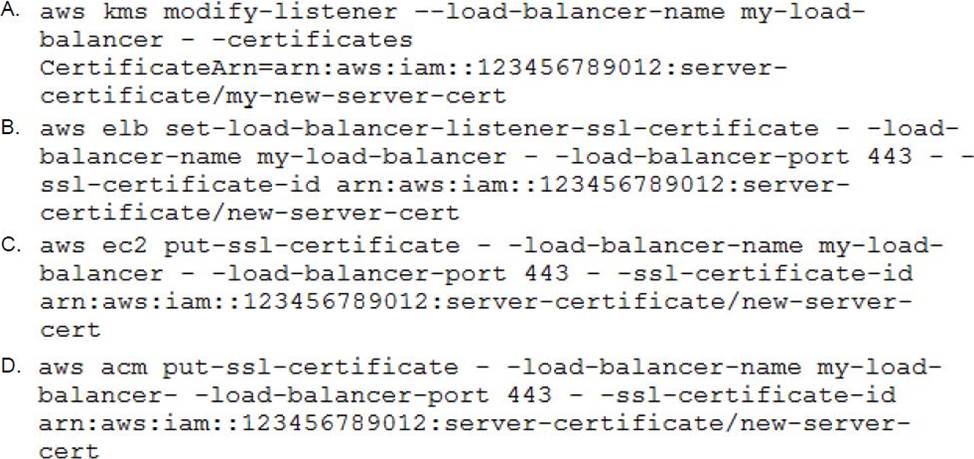
- A . Option A
- B . Option B
- C . Option C
- D . Option D
B
Explanation:
Reference https://docs.aws.amazon.com/ko_kr/cli/latest/reference/elb/set-load-balancer-listener-sslcertificate.html
A company has a sales department and a marketing department. The company uses one AWS account. There is a need to determine what charges are incurred on the AWS platform by each department. There is also a need to receive notifications when a specified cost level is approached or exceeded.
Which actions must a SysOps administrator take to achieve both requirements with the LEAST amount of administrative overhead? (Select TWO.)
- A . Use AWS Trusted Advisor to obtain a report containing the checked items in the Cost Optimization pillar.
- B . Download the detailed billing report, upload it to a database, and match the line items with a list of known resources by department.
- C . Create a script by using the AWS CLI to automatically apply tags to existing resources for each department. Schedule the script to run weekly.
- D . Use AWS Organizations to create a department Organizational Unit and allow only authorized personnel in each department to create resources.
- E . Create a Budget from the Billing and Cost Management console. Specify the budget type as Cost, assign tags for each department. define notifications, and specify any other options as required.
Latest SOA-C01 Dumps Valid Version with 254 Q&As
Latest And Valid Q&A | Instant Download | Once Fail, Full Refund
